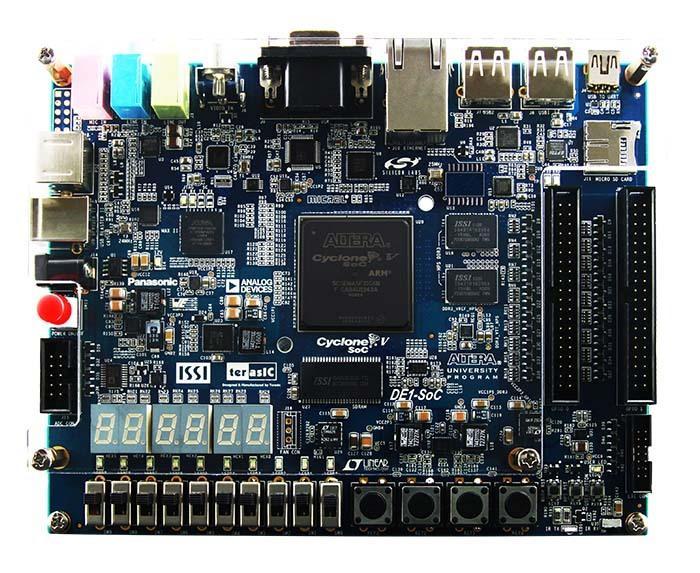
Students implement a Boolean function in VHDL as a canonical SOP, minimize it with a K-map, and try optional POS/MUX extensions on the DE1-SoC if time permits.
Derive a canonical sum-of-products (SOP) form from a truth table.
Minimize a Boolean function with a Karnaugh map and read off the simplified expression.
Bao gồm câu hỏi dành cho học sinh và lời nhắc trả lời.
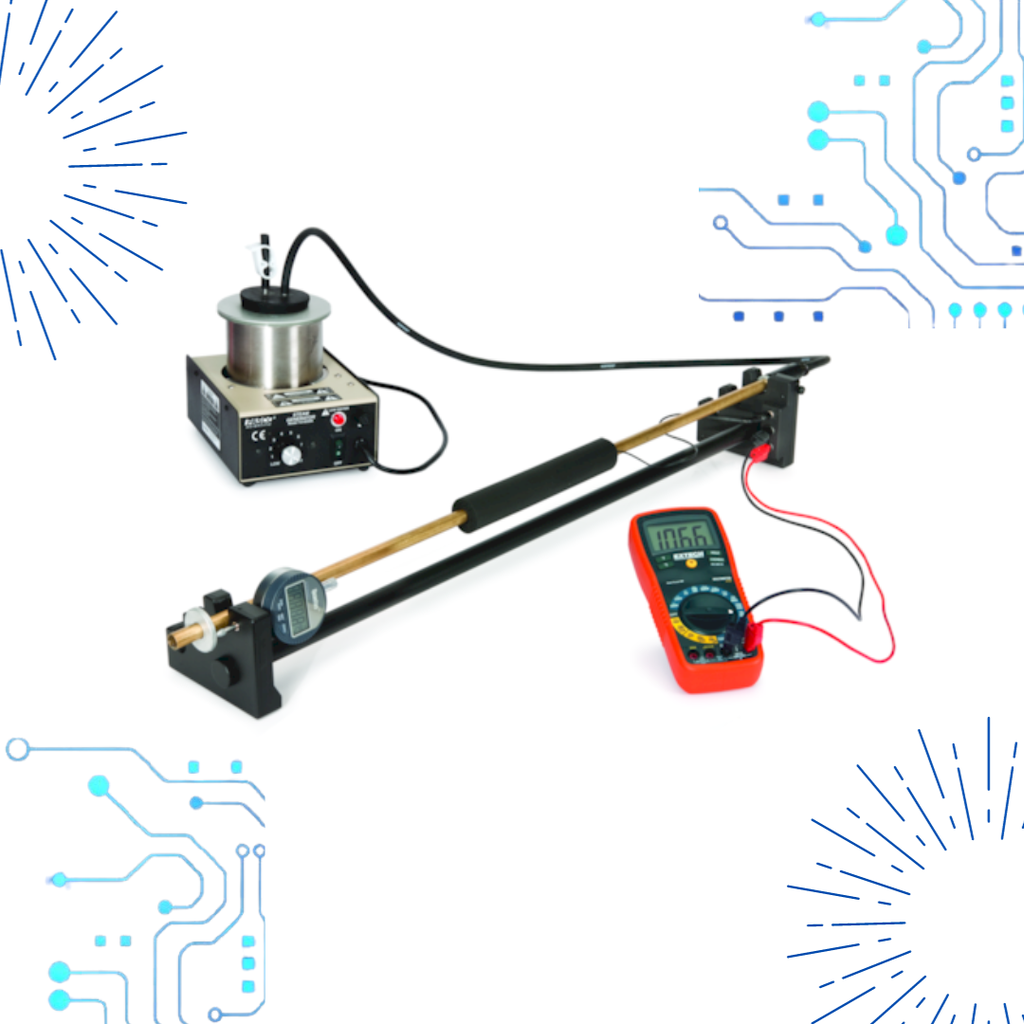
Os estudantes usam o laboratório remoto de Dilatação Térmica para comparar alumínio, cobre e latão e, em seguida, distinguem observações diretas de afirmações baseadas em um modelo.
Usar o modelo de dilatação linear para prever como os materiais devem se comparar.
Usar o laboratório remoto para observar pelo menos dois ensaios com materiais diferentes.
Bao gồm câu hỏi dành cho học sinh và lời nhắc trả lời.
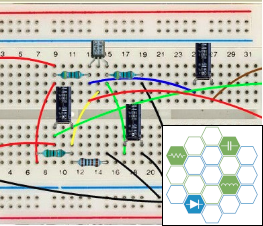
Students learn how breadboard holes form electrical nodes, trace a complete path, and confirm their interpretation with a real Hive resistance measurement.
Define an electrical node and identify connected breadboard holes.
Explain why the center trench separates the two terminal strips.
Bao gồm câu hỏi dành cho học sinh và lời nhắc trả lời.
Students choose DMM resistance or DC-voltage mode, connect across the correct nodes, preserve the required powered state, and interpret units and signs.
Choose resistance or DC-voltage mode for a stated measurement.
Explain why resistance is normally measured on an unpowered circuit.
Bao gồm câu hỏi dành cho học sinh và lời nhắc trả lời.
Students learn waveform, frequency, period, peak-to-peak amplitude, offset, and reference by configuring and observing a real Hive function-generator signal.
Identify sine, square, and triangle waveforms.
Define frequency, period, peak-to-peak voltage, amplitude, and DC offset.
Bao gồm câu hỏi dành cho học sinh và lời nhắc trả lời.
Students integrate breadboard, supply, DMM, generator, and oscilloscope reasoning in three real Hive checks and a reproducible troubleshooting handoff.
Choose the correct instrument and powered state for resistance, DC current, and time-varying voltage.
Apply a repeatable power-reference-source-path-mode-scale diagnostic sequence.
Bao gồm câu hỏi dành cho học sinh và lời nhắc trả lời.
El alumnado usa el laboratorio remoto Materials para comparar evidencias de dureza, impacto y tracción, y recomendar una combinación para una pieza que puede rayarse, golpearse o someterse a cargas capaces de superar el límite elástico y provocar deformación permanente o rotura.
Distinguir dureza, tenacidad y resistencia como propiedades diferentes.
Evaluar de forma preliminar la idoneidad de una combinación de material / aleación / tratamiento mediante evidencias de la sesión de laboratorio y de referencia.
Bao gồm câu hỏi dành cho học sinh và lời nhắc trả lời.
Os estudantes comparam gravações selecionadas do laboratório de Empuxo em água, óleo e água com açúcar para investigar como a densidade do líquido altera o limite entre flutuar e afundar.
Comparar a densidade de um objeto com a densidade de diferentes líquidos.
Explicar por que um mesmo tipo de objeto pode se comportar de maneira diferente em óleo, água e água com açúcar.
Bao gồm câu hỏi dành cho học sinh và lời nhắc trả lời.