
Teach lesson
Titration III: find the concentration of an unknown HCl solution
Students run the Acid Base Titration III remote lab hands-on — controlling the titrant flow, watching pH and colour respond, and judging the endpoint themselves — then read the burette and use the 1:1 reaction to find an unknown hydrochloric acid concentration, with attention to uncertainty.
Sign in with an educator account to prepare a class session. Students join with a class code.
New to LabsLand? Create your teacher account
Learning Outcomes
Explain what a titration measures and why catching the endpoint is the key skill.
Run the remote titration hands-on: add the titrant with the faucet and drop-by-drop controls and watch pH and colour respond.
Judge the endpoint yourself from the persistent colour change and the pH jump, and stop without overshooting.
Read the burette meniscus and subtract the initial from the final reading to find the volume of NaOH delivered.
Calculate the unknown HCl concentration from the one-to-one reaction between HCl and NaOH.
Discuss uncertainty (endpoint judgement, meniscus reading, overshoot) and write a claim-evidence-reasoning conclusion.
Student activity preview
Activity Content
Preview only. In a class session, students can fill in responses and submit their work to the teacher.
What a titration does (and why it is clever)
9 min
Someone hands you a bottle of hydrochloric acid and asks one simple question: how concentrated is it? You cannot tell by looking — the solution is clear and colourless. A titration is the clever trick chemists use to answer exactly that.
The idea: you slowly add a second solution whose concentration you do know — here, sodium hydroxide (a base) — into your unknown acid. The base neutralises the acid little by little. When exactly enough base has been added to neutralise all the acid, you have reached the equivalence point. Because the acid and the base react one molecule to one molecule, the volume of base needed to get there tells you how much acid was present, and so its concentration.
The catch is that you cannot see the equivalence point directly. Instead you watch for the endpoint: the first clear sign that you have just reached it. Two clues give it away — the pH, which jumps sharply, and the colour — an indicator in the flask turns pink the instant there is the tiniest excess of base. The whole skill is stopping right at that first persistent pink: stop too early and some acid is left; one drop too many and you have overshot.
The titration set-up
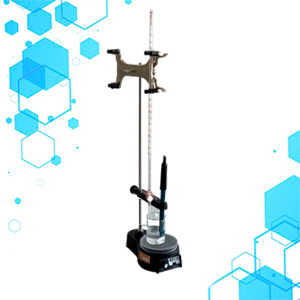
The base (NaOH) sits in the burette and drips into the acid below. A pH sensor reads the solution live, a stirrer keeps it mixed, and the indicator changes colour at the endpoint.
How the numbers work
HCl and NaOH react one-to-one, so the volume of base you deliver to reach the endpoint is what lets you work back to the acid's concentration. You measure that volume yourself from the burette.
Neutralization model
HCl + NaOH \rightarrow NaCl + H_2O

C_{\mathrm{HCl}}V_{\mathrm{HCl}} = C_{\mathrm{NaOH}}V_{\mathrm{NaOH,delivered}}
Plain version: because the reaction ratio is 1:1, C(HCl) x V(HCl) = C(NaOH) x V(NaOH delivered). Once you know the acid aliquot, the NaOH concentration and the NaOH volume you delivered, you can calculate the unknown acid concentration.
Why is the mole ratio one-to-one in this reaction?
Before you touch the lab, predict what will happen to the pH and the colour as you add NaOH to the acid. Say what you expect before the endpoint, right at it, and after it.
Get to know your tools and make a plan
8 min
You are about to run a real titration. First, get familiar with what you control and what you read.
You set the experiment up in the lab's Configuration step: choose the 0.100 mol/L sodium hydroxide as the titrant, and the unknown acid your teacher assigns (Acid #1 unless told otherwise). The lab then shows you the volume of acid in the flask (the aliquot), with its uncertainty — write it down, you need it for the calculation.
In the Observation step you actually do the titration:
- The burette holds the NaOH. The front-view camera shows its scale, so you read the level there.
- The pH meter (close-view camera) shows the pH of the solution live, changing as you add base.
- The flask sits on a stirrer and holds your acid plus an indicator that turns pink in base.
- Two controls add the base: the faucet adds a steady stream (fast), and the drop button (A) — hold it just long enough for a single drop, then release (precise).
The two ways to add the base
Use the faucet to add base quickly while you are still far from the endpoint. As the colour starts to flash pink and fade, close the faucet and switch to the drop button so you can stop on a single drop.
Your strategy: add quickly with the faucet at first; as the pink flashes start lasting longer and the pH climbs faster, switch to single drops. The endpoint is the first drop that turns the whole solution faintly, permanently pink — and the pH meter will have jumped. A flash of pink that disappears is not the endpoint. The endpoint is not the darkest pink; it is the first faint pink that remains after mixing. Stop there. One drop too many and the colour deepens: you have overshot.
You read the volume from the burette twice — once before you add anything (initial reading) and once at the endpoint (final reading). The difference is the volume of NaOH you delivered. Example: if your initial reading is 1.20 mL and your endpoint reading is 18.60 mL, delivered NaOH = 18.60 - 1.20 = 17.40 mL.
Reading the burette
Put your eye level with the liquid and read the scale at the bottom of the meniscus (the curved surface). The burette reads from the top down, so the level rises on the scale as base leaves it. Take an initial reading and an endpoint reading, and subtract.
Write a short plan (4-6 sentences) for your titration. Include: the titrant and unknown you will use, how you will use the faucet and the drop button, how you will read the burette, the two clues you will watch for the endpoint, and how you will avoid overshooting.
Run the titration and find the endpoint
23 min
Now do it. Take your time near the endpoint — that is where the measurement is won or lost. Record your own readings as you go; this is your evidence.
Open the titration lab
In Configuration, choose the 0.100 mol/L NaOH and your assigned unknown acid (Acid #1 unless told otherwise). Note the aliquot volume the lab shows.
In Observation, read and record your starting burette level from the front view.
Open the faucet to add NaOH steadily. Watch the pH meter climb and the colour in the flask.
When the pink flashes start lasting longer and the pH rises faster, close the faucet and switch to the drop button — hold it just long enough for one drop, then release and let the pH and colour settle.
Stop at the endpoint: the first time the whole solution stays faintly pink and the pH has jumped. Do not go to deep pink — that is past it.
Read and record your endpoint burette level.
Your titration observations
Record your own readings as you titrate — one row per stage. Use at least these six: (1) start, before adding any base; (2) early addition; (3) mid-run; (4) the first pink flashes; (5) adding drop by drop near the endpoint; (6) the endpoint. For each row note the stage and the colour, and record the pH and the burette level at least at the start and at the endpoint.
| Stage | pH (from meter) | Burette reading mL | Colour in the flask | Note |
|---|---|---|---|---|
Endpoint screenshot
Capture one screenshot at your endpoint or just after it — the flask showing the first persistent pink, and/or the pH meter at the jump. Add it here as an image or paste a link. If you missed the exact screenshot or cannot insert one, describe the endpoint colour, pH reading and burette reading in detail.
Work out the unknown concentration
12 min
The calculation uses the volume of NaOH you delivered, not the final burette reading on its own. Do not use the endpoint burette reading as the delivered volume. Delivered volume = endpoint reading - initial reading.
Worked example with fake numbers: if the acid aliquot is 20.00 mL, the NaOH concentration is 0.100 mol/L, and the delivered NaOH volume is 17.40 mL, then C(acid) = (0.100 x 17.40) / 20.00 = 0.0870 mol/L.
From volume to concentration
Fill in your own measured values. Keep both volumes in the same unit (mL is fine — the units cancel in the ratio). Report the final concentration in mol/L.
| Run | Acid aliquot mL | NaOH concentration mol/L | Initial burette reading mL | Endpoint burette reading mL | NaOH delivered mL | Calculated acid concentration mol/L |
|---|---|---|---|---|---|---|
Using your own observations, explain how you knew you had reached the endpoint. What did you see in the colour and the pH just before you stopped, and what would have told you that you had gone one drop too far?
Work out the volume of NaOH you delivered, in mL. Enter your endpoint burette reading minus your initial reading, and show the subtraction.
Now find the acid concentration in mol/L. Use the relationship C(acid) x V(acid) = C(NaOH) x V(NaOH delivered), and show your substitution with your acid aliquot, the 0.100 mol/L NaOH, and your delivered volume.
Judge your uncertainty and state your answer
8 min
The best answer is not the one with the most decimal places. It is the one that is tied to your evidence and honest about how sure you can be.
Suppose you overshot and recorded a NaOH volume that is too large. What does that do to your calculated acid concentration?
Name two things in your run that make the answer uncertain, and explain how each one could push the delivered volume or the final concentration up or down.
Write your final answer as a short claim. Include: (1) the concentration you found, with units; (2) the volume of NaOH you delivered; (3) two pieces of your own evidence (pH, colour and/or burette readings) that support it; (4) how you knew you were at the endpoint; and (5) one source of uncertainty.
Sentence frame you may use: My unknown HCl concentration was approximately ___ mol/L. I delivered ___ mL of 0.100 mol/L NaOH, from an initial burette reading of ___ mL and an endpoint reading of ___ mL. I knew I had reached the endpoint because ___. My result is uncertain because ___.
Optional extension: go further
20 min
Use this only if your teacher sets the longer version and your lab access allows it.
You found the endpoint using both the colour and the pH meter. Which clue did you trust more, and why? Where could each one mislead you?
If your teacher gives you a second unknown acid, how would you keep the comparison fair, and what would you expect to be different about the volume of base you need?
Turn this preview into a live class session
Continue to LabsLand Teach to use this lesson with your students and review the access available to your account.
New to LabsLand? Create your teacher account